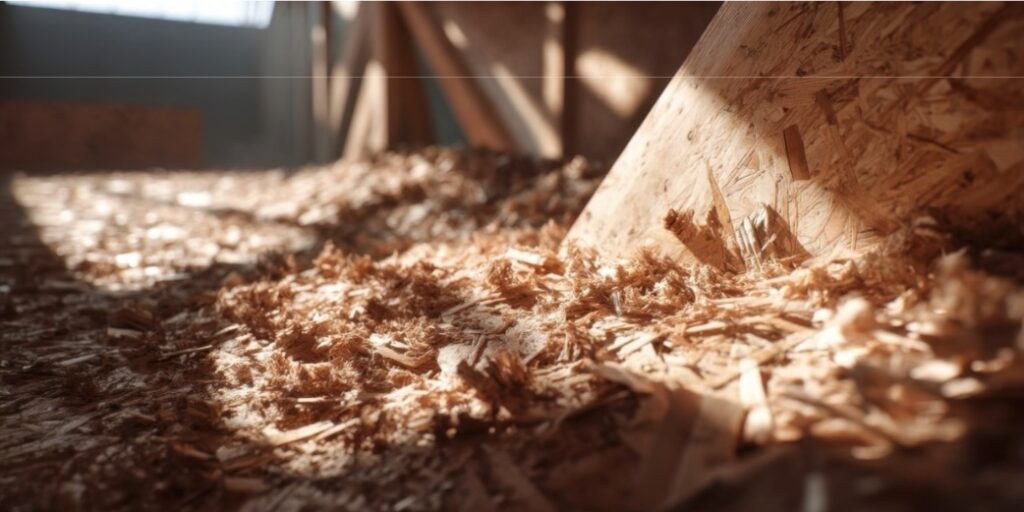
A major OSB manufacturer had already evaluated spray systems from catalog nozzle vendors — and found that off-the-shelf components couldn’t handle high-viscosity wax emulsion at the required flow rates, or survive the environment inside a blender drum. They needed an engineered solution, not a catalog product. Spraymation designed a fully automated wax emulsion spray system custom-built for the manufacturer’s blender geometry, strand throughput, and wax properties. Within 60 days: wax consumption down 30%, press cycle time down 15%, and more than $150,000 in annual savings.
Results at a glance
30%
Reduction in wax consumption
15%
Decrease in press cycle time
<1 Year
Payback period
$150K+
Annual cost savings
Project Overview
Industry
Oriented Strand Board (OSB) Manufacturing
Application
Blender Wax Emulsion Coating
Product
OSB Wood Strand (Flake)
Coating
Wax Emulsion (Moisture Barrier)
The Challenge
Wax emulsion is a critical additive in OSB production. It creates the moisture barrier that prevents edge swell and thickness swell in the finished board — directly impacting structural performance and customer acceptance.
The existing application method — gravity-fed drip bars inside the blender drum — was creating compounding problems across multiple blender lines:
[01]
Inconsistent coverage.
Drip bars delivered wax in heavy streams rather than atomized droplets. Some strands were over-coated while others went untreated, producing inconsistent board density and moisture resistance across the panel.
[02]
Excessive wax consumption.
To compensate for poor distribution, operators ran wax flow 25–35% above the theoretical minimum — inflating raw material costs on every shift.
[03]
Blender drum buildup.
Unatomized wax accumulated on drum walls, flights, and discharge areas, forcing 4–6 hour manual cleaning shutdowns on each blender line every two weeks.
[04]
Extended press cycle time.
Uneven wax distribution forced longer press cycles to guarantee minimum internal bond (IB) strength — throttling throughput of the continuous press.
[05]
Quality holdbacks.
Panels with visible wax streaking or inconsistent swell performance were flagged by QC, increasing downgraded product sold at reduced margin or scrapped outright.
The Spraymation Solution
Spraymation engineered a fully automated wax emulsion spray system custom-designed for the manufacturer’s blender drum geometry, strand throughput rates, and wax emulsion properties.
Key System Components
Custom spray headers with air-atomizing nozzles. Engineered-to-order headers mounted inside the blender drum, fitted with nozzles sized for the wax emulsion’s viscosity and flow requirements. A fine, uniform mist replaced heavy drip streams — dramatically improving strand-to-strand coating consistency.
Closed-loop spray controller. A programmable controller automatically adjusts wax flow in proportion to strand feed rate. As production speed changes, wax output scales in real time — eliminating operator guesswork and over-application.
Heated fluid delivery system. Integrated heated supply maintains the wax emulsion at optimal viscosity from tank to nozzle, preventing the cold-weather thickening that previously clogged drip bars and stopped lines in winter.
Heavy-duty construction for the blender environment. All spray components are built from hardened stainless steel and wear-resistant materials rated for the abrasive, high-temperature drum interior. Quick-disconnect fittings allow nozzle replacement inside scheduled maintenance windows.
Engineering Approach
Spraymation’s engineers conducted on-site analysis of the blender lines — drum geometry, strand flow patterns, existing wax delivery infrastructure, and target application weights — then characterized the wax emulsion’s atomization behavior across the full operating temperature range through fluid testing at Spraymation’s facility. The system was engineered, assembled, and factory acceptance tested (FAT) in Fort Lauderdale before shipment, and commissioned within a single planned maintenance window with no unscheduled downtime.
The Results
Within 60 days of commissioning,the manufacturer documented:
30% reduction in wax emulsion consumption.
Precision atomization and closed-loop flow control ended years of chronic over-application — over $150,000 in annual savings at current wax pricing.
15% decrease in press cycle time.
Uniform distribution let the manufacturer shorten press time while still meeting IB and thickness swell specifications — measurable daily panel output gained with zero press capex.
Blender drum buildup eliminated.
The 4–6 hour biweekly cleaning shutdowns are gone. Maintenance labor was reallocated to higher-value work and blender uptime increased.
Reduced quality holdbacks.
Consistent coverage eliminated the streaking and edge-swell variability driving downgrades — more panels meeting premium-grade spec, improving realized margin per MSF.
< 12 months.
Payback in under 12 months.
Combined savings in wax, downtime, throughput, and scrap returned the full investment within the first year.
If catalog spray components have already failed in your process — high-viscosity fluids, harsh environments, demanding flow rates — that’s exactly where Spraymation’s engineering starts.