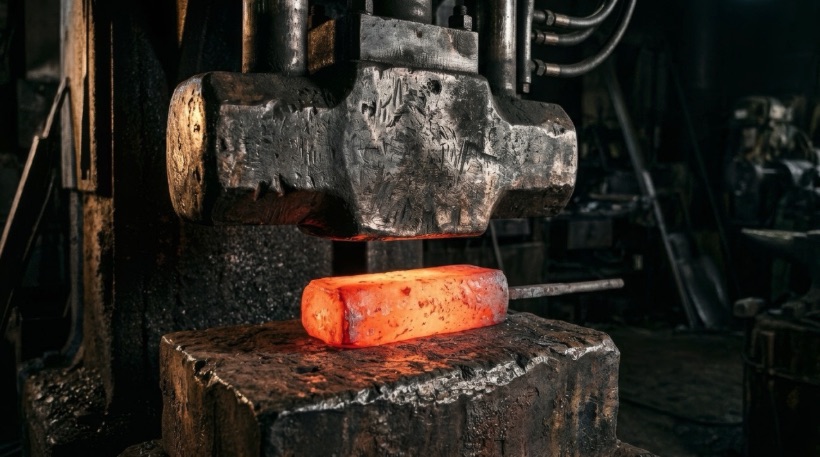
Precision Die Lubrication for High-Pressure Forging
A major automotive parts manufacturer was overdosing its forging die lubricant by 83% — delivering 2.2 grams per shot against a 1.2-gram specification — because its pneumatic pump system couldn’t dose repeatably inside a 3.5-second forging cycle. Spraymation engineered a dual-channel precision dispensing system that dropped into the plant’s existing PLC, manifold, and nozzle infrastructure. The result: on-spec dosing, $46,500 in annual lubricant waste eliminated, water use cut in half, and full payback in under three months.
Results at a glance
$46,500
Annual lubricant cost eliminated
<3 Mo
Payback period
50%
Reduction in water usage
83%
Overdose eliminated
Project Overview
Industry
Automotive Parts Manufacturing
Application
Die Lubrication — High-Pressure Forging
Product
Steel Engine Valves
Coating
Oil-Based Graphite Die Lubricant
The Challenge
The manufacturer operates a high-pressure forging process (500 PSI) using oil-based graphite die lubricant to form steel billets into unfinished engine valves. The process requires two different lubricant weights applied at two separate intervals — inside a tight 3.5-second cycle. Precision is non-negotiable: too much lubricant drives up material costs, while too little locks the forging die and causes costly downtime.
The existing PLC-controlled system — two pneumatic diaphragm pumps feeding pressurized lubricant through OEM manifolds — created compounding problems:
[01]
PLC reprogramming downtime.
Any timing adjustment required an engineer, leaving the line idle while changes were made.
[02]
Unreliable pumps.
The pneumatic diaphragm pumps could not deliver consistent shot weights at cycle speed.
[03]
Non-repeatable dosing.
The system was delivering 2.2 grams per shot against a 1.2-gram specification — an 83% overdose on every cycle.
[04]
Rising costs.
Excess consumption drove up both lubricant purchasing and drum recycling expenses.
The Spraymation Solution
Spraymation engineered a dual-channel precision dispensing system to replace the unreliable pump setup — integrating seamlessly with the customer’s existing PLC, manifold, and nozzle infrastructure.
Key System Components
Dual Channel 2008 Controller. Receives the existing PLC trigger input. Channel A is programmed to deliver 0.8 g (time-based), with Channel B delivering 0.4 g on a slight delay — coordinated to Step 2 of the forging die cycle.
24 VDC air solenoids. Controller outputs drive a pair of air solenoids controlling two 22AUH spray nozzles — fast, repeatable actuation within the 3.5-second cycle.
Drop-in integration. The solution reused the customer’s existing manifold and nozzle infrastructure, minimizing installation complexity and line downtime.
Validation Process
Before installation, 20 dose samples were collected from the existing pumps to establish a quantified baseline — testing that confirmed the 83% overdose. The Spraymation system was then validated against the same sampling protocol, confirming accurate, repeatable dosing at the engineered weights before commissioning. Baseline first, proof second: the same measurement discipline Spraymation applies to every system it ships.
The Results
Metric
Before
After
Annual Impact
Annual lubricant cost
31 drums/yr @ $1,500
Precise, on-spec dosing
$46,500/yr saved
Drum recycling cost
31 drums @ $10
Reduced drum count
$310/yr saved
Water for die cleanup
50 gal/day
25 gal/day
50% reduction
Dose accuracy
2.2 g (83% over spec)
1.2 g (on spec)
Repeatable and accurate
System adjustments
Engineer required
Operator adjustable
Downtime eliminated
The financial picture: At 17 grams per minute, 20 hours a day, 6 days a week, 50 weeks a year, the legacy system consumed roughly 13,600 lbs of lubricant annually — 31 fifty-five-gallon drums at $1,500 each. On-spec dosing eliminated that waste entirely. Add $310 per year in drum recycling and an estimated $780 per year in water and sewer savings from halved die-cleanup water use, and the total payback period came in under three months.
The environmental picture: The 50% water reduction also meaningfully cut hazardous waste generation — fewer recycled drums and less oil-contaminated wastewater entering the plant’s waste stream.
If your dispensing process is overdosing to stay safe — or your dosing system needs an engineer every time it needs an adjustment — Spraymation can quantify your baseline, engineer the fix, and validate it against your own spec before it ships.