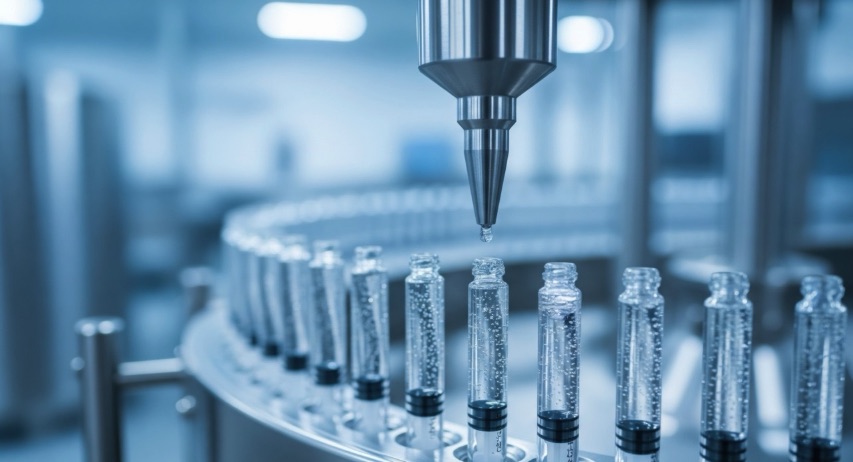
Precision Siliconizing for Pre-Filled Syringe Manufacturing
A medical device manufacturer producing pre-filled glass syringes for injectable biologics couldn’t validate its siliconization process — coating weight variability exceeded 25% CV against an FDA process-validation target of under 10%, and bare patches at the needle-end of the barrel were causing glide force failures in the most critical spot of the plunger stroke. Spraymation engineered a production-grade siliconizing system around its Electromatic™ applicator platform. The outcome: 0.25 mg dispensing precision, coating weight CV below 8%, a 99.9% glide force pass rate, and 35% less silicone oil consumed.
Results at a glance
35%
Reduction in silicone usage
99.9%
Glide force pass rate
<1 Year
Payback period
0.25 mg
Dispensing precision
Project Overview
Industry
Medical Device Manufacturing
Application
Syringe Barrel Siliconizing
Product
1 mL Pre-Filled Glass Syringes
Coating
Medical-Grade Silicone Oil (PDMS)
The Challenge
The interior barrel of every pre-filled syringe must be coated with a precise, uniform layer of medical-grade silicone oil (polydimethylsiloxane / PDMS) so the plunger stopper glides smoothly during injection. That silicone layer controls two critical functional parameters: break-loose force and glide force. If either is too high, the syringe becomes difficult to use — and in autoinjector applications, can stall entirely, resulting in an incomplete dose.
The manufacturer’s existing third-party diving-nozzle spray unit was producing unacceptable variability:
[01]
Non-uniform silicone distribution.
The nozzle deposited silicone unevenly along the barrel. The needle-end consistently received insufficient coating, creating bare patches and elevated glide force in the lower third of the plunger stroke — the exact failure mode that stalls an autoinjector before the full dose delivers.
[02]
High batch-to-batch variability.
Coated silicone weight varied more than ±30% across production runs, with coefficient of variation exceeding 25% — far above the <10% target required for process validation under FDA 21 CFR 820. GMP validation was impossible.
[03]
Excess silicone driving subvisible particles.
Operators compensated for poor distribution by raising the silicone target well above the functional minimum. Free silicone oil migrated into the drug product during storage, forming subvisible droplets that risked protein aggregation in the biologic formulation — flagged during accelerated stability testing.
[04]
Tubing flex and mis-spray events.
Flexible tubing in the fluid path introduced random pressure fluctuations, causing intermittent mis-sprays — barrels with no coating or grossly uneven coating — caught only at downstream glide force testing.
[05]
No path to production scale.
The bench-top unit suited R&D quantities but couldn’t hold coating precision at the cycle times of commercial inline or rotary filling machines.
The Spraymation Solution
Spraymation engineered a production-grade siliconizing system built around its Electromatic™ applicator platform, purpose-designed for high-speed, sub-milligram dispensing of medical-grade silicone into syringe barrels, catheter lumens, and needle cannulae.
Key System Components
Electromatic™ 29 silicone applicator. A wider spray pattern optimized for 1 mL barrel geometry, with an internal-mix atomizer producing an extremely fine, uniform mist at dispensing precision down to 0.25 mg. Integrated heaters with platinum RTD temperature control maintain silicone at optimal viscosity up to 12,500 cPs — critical for baked-on siliconization, where higher-viscosity silicone reduces particle migration.
Diving nozzle with programmable retraction. A linear actuator dives into the barrel and retracts at controlled speed during the spray cycle. Nozzle spray range, retraction speed, and air-to-nozzle pressure are independently programmable — the three parameters published research identifies as critical to distribution uniformity. A rigid fluid delivery path from pump to nozzle eliminates the tubing flex problem outright.
Constant pressure fluid source. A Spraymation constant-pressure tank delivers silicone at stable, repeatable pressure independent of fluid level — removing the pressure drift behind batch-to-batch variability.
Silicone controls with recipe management. Validated process recipes are stored per syringe format (barrel size, silicone grade, target weight). Changeover is electronic — no manual valve adjustments — enabling fast product transitions while preserving validation status.
Inline and rotary machine compatibility. Engineered to integrate directly into the manufacturer’s existing rotary filling machine, matching index time within the available station footprint. CE-declared with IEC connectors and over-temperature protection for global deployment.
Engineering Approach
Spraymation’s engineers worked with the manufacturer’s process development and quality teams to characterize the required coating weight, distribution profile, and glide force specification. Nozzle geometry, retraction rate, and air pressure were optimized at Spraymation’s facility using the manufacturer’s actual syringe barrels and silicone grade. Coating uniformity was verified by glass powder visualization testing and Instron glide force measurement at multiple points along the barrel. The system was factory acceptance tested to the manufacturer’s IQ/OQ protocol requirements before shipment — accelerating process validation at the production site.
The Results
99.9% glide force pass rate.
Uniform distribution eliminated the needle-end bare patches behind glide force failures. Break-loose and glide profiles are now consistent across the full barrel length — meeting autoinjector compatibility requirements for the first time.
Silicone weight CV below 8%.
Variability dropped from >25% to under 8% — comfortably inside the FDA validation threshold. Process validation (PQ) was completed within four months of installation.
35% reduction in silicone oil consumption.
With uniform distribution, the target weight was reduced to the true functional minimum — and lower silicone loading also cut subvisible particle counts in accelerated stability studies, improving the drug product’s particulate profile.
Mis-spray events eliminated.
The rigid fluid path and constant-pressure supply ended the random mis-sprays driving inspection rejects. Scrap from siliconization defects dropped to near zero.
< 12 months.
Payback in under 12 months.
Savings across silicone consumption, scrap, rework, and faster validation returned the investment within the first year of production.
If catalog spray components have already failed in your process — high-viscosity fluids, harsh environments, demanding flow rates — that’s exactly where Spraymation’s engineering starts.